
An emotional healing journal: what writing can do, what it can't, and how to use one
7 min read · Updated · Khram
A journal can't fix your life. It can give a feeling somewhere to go besides around and around in your head. That turns out to matter.

What the research says
Psychologists have studied this for about 40 years under the name expressive writing. In the first studies, people wrote about their deepest thoughts and feelings on a difficult experience for 15 to 20 minutes, on several days in a row. Compared with people who wrote about neutral topics, they visited the health center less often in the months that followed (Pennebaker & Beall, 1986).
Later reviews pooled many of these experiments and found a benefit that is real but small on average, for both physical and emotional measures (Smyth, 1998; Frattaroli, 2006). Small is the honest word. Writing helps some people a lot, some a little, and some not at all.
One reason it may help: naming a feeling seems to take some of the heat out of it. In a brain-imaging study, simply putting a word to the emotion in a photo, like “angry” or “scared,” reduced activity in the amygdala, a part of the brain involved in alarm (Lieberman et al., 2007). Writing “I feel ashamed” is a small act of naming.
What a journal can't do
- It can't replace a therapist, a doctor or medication.
- It can't make every painful memory safe to open alone. If writing brings up panic, flashbacks or thoughts of hurting yourself, stop and reach out to someone.
- It doesn't work on a deadline. “Healed in 30 days” is marketing, not psychology.
How to write without spiraling
The difference between processing and ruminating is direction. Rumination loops on “Why does this always happen to me?” Processing moves: what happened, what I felt, what it reminds me of, what I need.
- Name it first. Start with one feeling word: “Hurt.” “Embarrassed.” “Tired of trying.”
- Describe, then make sense of it. Write what happened, then what you felt, then what you think it means. In one study, people whose writing moved toward understanding over several days, using more words like “because” and “realize,” were the ones whose health improved most (Pennebaker, Mayne & Francis, 1997).
- Set a timer. Ten to twenty minutes. Stop when it rings.
- Step back if you're stuck. Write the moment as if it happened to a friend, or use your own name instead of “I.” Researchers call this self-distancing, and it can make hard feelings easier to look at (Kross et al., 2014).
- End somewhere steady. Finish with one line about what you'll do next: drink some water, go to sleep, text a friend.
What a good emotional healing journal includes
- Prompts that start with noticing before they ask you to change anything.
- Space after each prompt. Real feelings need more than three lines.
- A way to see the nights add up, like a simple tracker.
- Room for feelings that rarely get any: anger, envy, grief, being tired of being the strong one.
- A note on where to get help, because a responsible journal includes one.
How INDIGO is built
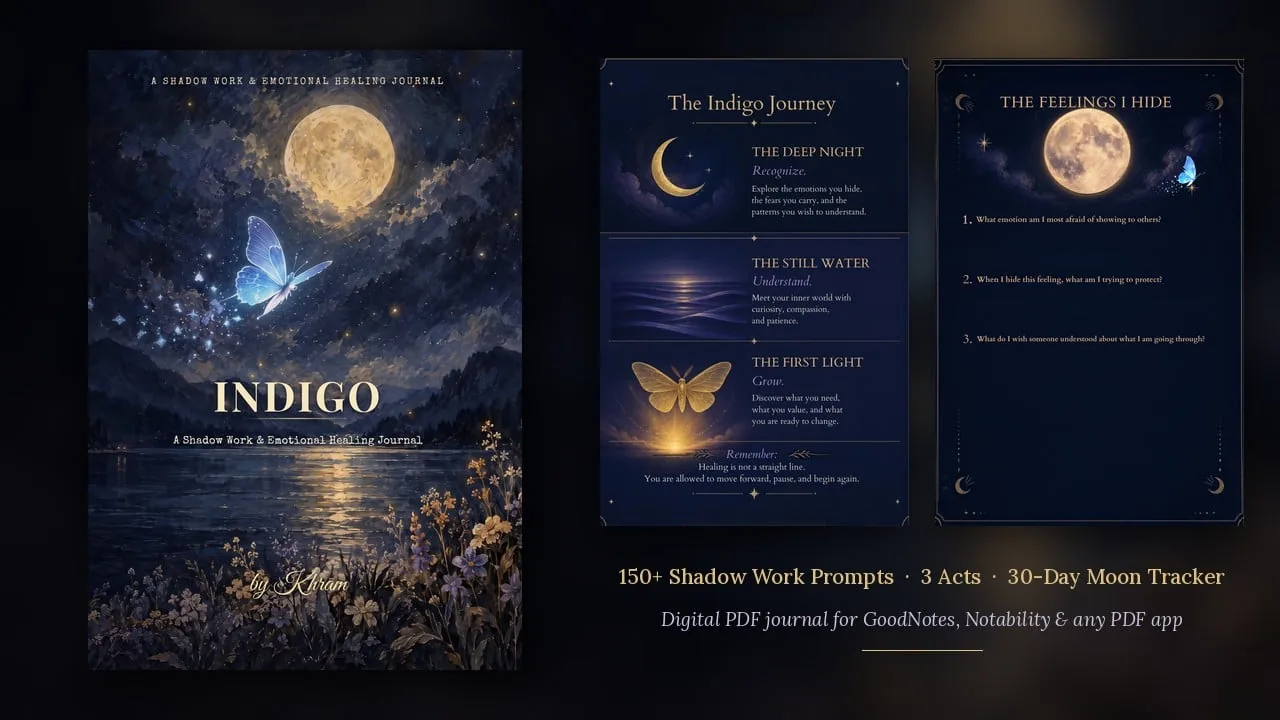
INDIGO follows that shape in three Acts. The Deep Night is for recognizing: the emotions you hide and the patterns you keep repeating. The Still Water is for understanding: gentle inner child work, the rules you learned growing up, the boundaries you never got to set. The First Light is for growing: what you need, what you value, what you're ready to change. Every prompt page is followed by a full page to write on, and a 30-night moon tracker lets you watch the nights add up.
The name Khram (คราม) comes from the life of the person who makes these journals: an ordinary person who has gotten a lot wrong, nearly died once, and decided not to give up this time. The line the brand keeps coming back to is "I did the best I could." (Our story.) Whether INDIGO is right for you is something you'll have to find out for yourself. Ten minutes tonight. Again tomorrow. Still here. Still walking.
Khram journals and guides are self-reflection tools, not a substitute for professional mental health care. If you are in crisis or thinking about hurting yourself, call or text 988 in the US, contact your local emergency number, or find a helpline at findahelpline.com (opens in a new tab).
Sources
- Pennebaker, J. W., & Beall, S. K. (1986). Confronting a traumatic event: Toward an understanding of inhibition and disease. Journal of Abnormal Psychology, 95(3), 274–281. (opens in a new tab)
- Smyth, J. M. (1998). Written emotional expression: Effect sizes, outcome types, and moderating variables. Journal of Consulting and Clinical Psychology, 66(1), 174–184. (opens in a new tab)
- Frattaroli, J. (2006). Experimental disclosure and its moderators: A meta-analysis. Psychological Bulletin, 132(6), 823–865. (opens in a new tab)
- Lieberman, M. D., et al. (2007). Putting feelings into words: Affect labeling disrupts amygdala activity in response to affective stimuli. Psychological Science, 18(5), 421–428. (opens in a new tab)
- Pennebaker, J. W., Mayne, T. J., & Francis, M. E. (1997). Linguistic predictors of adaptive bereavement. Journal of Personality and Social Psychology, 72(4), 863–871. (opens in a new tab)
- Kross, E., et al. (2014). Self-talk as a regulatory mechanism: How you do it matters. Journal of Personality and Social Psychology, 106(2), 304–324. (opens in a new tab)
Keep reading

Getting started
Shadow Work Journal for Beginners: How to Start Gently
What shadow work is, how to start journaling about it safely, a simple 10-minute routine, 12 beginner prompts, and what to look for in a shadow work journal.
7 min read
Digital journaling
Digital Shadow Work Journal for iPad: GoodNotes & Notability Guide
Paper or digital? How to open a shadow work journal PDF in GoodNotes or Notability, pen colors that work on dark pages, finding your place, and keeping it private.
6 min read
Journal prompts
60 Shadow Work & Self-Reflection Journal Prompts (Free List)
60 free journal prompts for shadow work and self-reflection, grouped by theme: hidden feelings, overthinking, people-pleasing, anger, envy, inner child, relationships and self-worth.
9 min read