
Shadow work for beginners: how to start a journal without drowning in it
7 min read · Updated · Khram
Shadow work sounds bigger than it is. Most nights it's one honest question, ten minutes, and a page you never have to show anyone.

What shadow work actually means
The idea comes from the psychiatrist Carl Jung. He used “the shadow” for the parts of ourselves we push out of view because they didn't feel safe or welcome when we were growing up: anger we learned to swallow, needs we were told were too much, envy, fear, even talents someone laughed at. Those parts don't disappear. They tend to show up sideways, in habits we can't explain and reactions that feel too big for the moment.
Shadow work is the slow practice of noticing those parts and getting curious about them instead of fighting them. A journal suits it well, because writing slows your thoughts down enough to actually look at them.
It isn't a diagnosis, a cure or a replacement for therapy. It's a way of paying attention.
Signs it might be worth trying
- You say “I'm fine” and mean “I don't want to talk about it.”
- You replay conversations long after they're over.
- You say yes when you want to say no, then feel resentful.
- One small comment can ruin your whole day, and you're not sure why.
- You keep meeting the same pattern in different relationships.
None of these mean something is wrong with you. They're simply good places to start looking.
Three ground rules before you start
- Go small. Ten minutes is enough. Stop when the timer ends, even mid-sentence.
- Write for nobody. No grammar, no audience, no neat conclusions. Messy is the point.
- Know your exit. If a memory feels too heavy to hold alone, close the journal and do something that steadies you: a walk, a shower, a message to someone safe. Some things are better opened with a therapist in the room, and choosing that isn't failure.
Research on expressive writing backs up going gently. In James Pennebaker's early studies, people wrote about a hard experience for 15 to 20 minutes on a few days in a row. Many felt worse right after writing, yet over the following months they visited the health center less often than people who wrote about neutral topics. Short, repeated sessions do more than one big emotional dump.
A simple 10-minute routine
- Settle (1 minute). Sit where you won't be interrupted. Take three slow breaths.
- Read one prompt (1 minute). Just one. Don't skip ahead.
- Write (7 minutes). Start with the first true sentence that comes, even if it's “I don't know.”
- Close (1 minute). Write one line about how you feel now. Then put the journal away.
Night is when many people overthink most, which makes it a natural time to write. If nights make it worse for you, try the morning. Doing it regularly matters more than the hour.
12 shadow work prompts for beginners
Take one per night. If a question feels too sharp, skip it and come back another time.
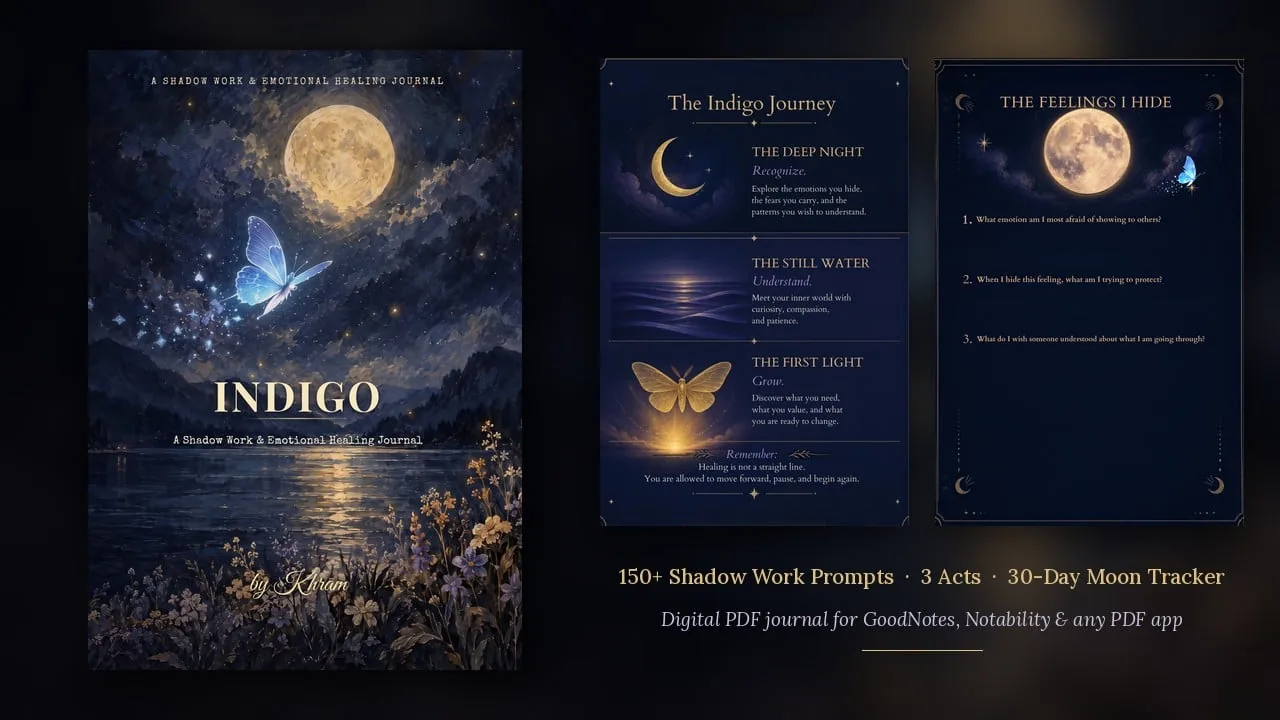
- What emotion am I most afraid of showing to others?
- When I hide this feeling, what am I trying to protect?
- What do I say “I'm fine” about most often?
- Whose approval do I still work for, even when they're not around?
- What did I learn as a child about anger? Who taught me?
- When did I last say yes when I meant no? What was I afraid would happen?
- What trait in other people irritates me most? Where might it live in me?
- What do I envy in someone else's life? What does that envy say I want?
- Which compliment do I brush off every time? Why is it hard to accept?
- What part of me did I hide to fit in?
- What would I do differently if no one could be disappointed in me?
- What do I need right now that I haven't asked for?
Want more? Here are 60 shadow work and self-reflection prompts, grouped by theme.
What to look for in a shadow work journal
- Prompts in an order, from noticing to understanding to change, so night one doesn't drop you into the deepest questions.
- Room to write. Three lines under a prompt don't leave space to think. Look for a full page per prompt.
- A way to see small progress, like a tracker you fill in after each night.
- Plain language. If the prompts read like a textbook, you'll stop opening it.
- Honest claims. Be wary of any journal that promises to heal trauma or fix anxiety in 30 days.
Where Khram fits
We made INDIGO for exactly this: 150+ prompts in three Acts (The Deep Night, The Still Water and The First Light), a full writing page after every prompt, and a 30-night moon tracker. It comes as a digital PDF for iPad and tablets or as a paperback in full color or black and white.
Not ready for a full journal? 7 Nights in INDIGO is free: fourteen prompts from INDIGO for one week, pay what you want.
Khram journals and guides are self-reflection tools, not a substitute for professional mental health care. If you are in crisis or thinking about hurting yourself, call or text 988 in the US, contact your local emergency number, or find a helpline at findahelpline.com (opens in a new tab).
Sources
- Jung, C. G. (1959). Aion: Researches into the Phenomenology of the Self. Collected Works, Vol. 9, Part II. Princeton University Press.
- Pennebaker, J. W., & Beall, S. K. (1986). Confronting a traumatic event: Toward an understanding of inhibition and disease. Journal of Abnormal Psychology, 95(3), 274–281. (opens in a new tab)
Keep reading
Digital journaling
Digital Shadow Work Journal for iPad: GoodNotes & Notability Guide
Paper or digital? How to open a shadow work journal PDF in GoodNotes or Notability, pen colors that work on dark pages, finding your place, and keeping it private.
6 min read

Healing journals
Emotional Healing Journal: What Writing Can (and Can't) Do
What 40 years of research says about writing through hard feelings, how to journal without spiraling, and when a journal isn't enough. Honest, no 30-day promises.
7 min read

Journal prompts
60 Shadow Work & Self-Reflection Journal Prompts (Free List)
60 free journal prompts for shadow work and self-reflection, grouped by theme: hidden feelings, overthinking, people-pleasing, anger, envy, inner child, relationships and self-worth.
9 min read